

Simple Ways to Get More Value From Savvy Car Insurance Savings

Discover simple ways to maximize your Savvy Car Insurance Savings without compromising essential coverage. Learn how to compare insurance quotes, find available discounts, choose the right deductible, review your coverage, and make smarter decisions to reduce unnecessary car insurance costs.
Table of Contents
What Savvy Car Insurance Savings Really Mean
Getting more value from car insurance does not always mean finding the cheapest policy available. A low premium can look attractive, but it may come with higher deductibles, fewer benefits, or limits that do not fit your needs. Savvy car insurance savings are about finding a sensible balance between price, protection, service, and flexibility. The first step is to understand what you are actually paying for. Once you know the details of your policy, it becomes much easier to identify areas where you may be paying too much or missing discounts that could lower your cost.
Look Beyond the Advertised Premium
Insurance companies use many factors to calculate premiums, including location, driving history, vehicle type, coverage choices, and other personal rating factors. The exact rules differ by insurer and location, so two drivers with similar vehicles may receive very different quotes. A useful comparison should look at the full policy cost and coverage, rather than focusing only on the headline monthly payment.
For example, one quote may be cheaper because it has a higher deductible. Another may cost slightly more but offer better roadside assistance or stronger rental-car coverage. Think of insurance like buying a pair of shoes: the lowest price is not necessarily the best value if the product does not fit your needs.
Why Insurance Premiums Vary


Two drivers with similar cars can receive very different car insurance quotes because insurers evaluate risk differently. Annual mileage, vehicle use, driving record, location, vehicle model, and selected coverage can all affect the premium. Some insurers may also use additional rating factors where permitted by local law.
This is why simply asking, “What is the cheapest car insurance?” may not give you the most useful answer. Instead, ask, “What combination of car insurance coverage, price, deductible, and discounts gives me appropriate protection at a reasonable cost?” That small change in thinking can help you find more meaningful insurance savings.
Start by Understanding Your Current Policy
Before searching for savings, read your current policy. You do not need to become an insurance expert, but you should know your liability limits, collision and comprehensive coverage, deductibles, exclusions, optional benefits, and policy discounts. Many drivers renew their policies year after year without checking whether their circumstances have changed. That can make it easy to keep paying for coverage or options that no longer make sense.
Check Your Coverage and Deductibles
Your deductible is the amount you generally pay toward a covered claim before the insurer pays the remaining covered amount, subject to the policy terms. Increasing a deductible can sometimes reduce the premium, while choosing a lower deductible can increase the premium. The right choice depends on your finances and how comfortable you are with paying more out of pocket after a claim.
Do not raise the deductible simply to chase a lower premium. If a higher deductible would be difficult for you to afford, the monthly saving may not be worth the added financial risk. A better approach is to compare several deductible options and consider the potential savings over a full policy year.
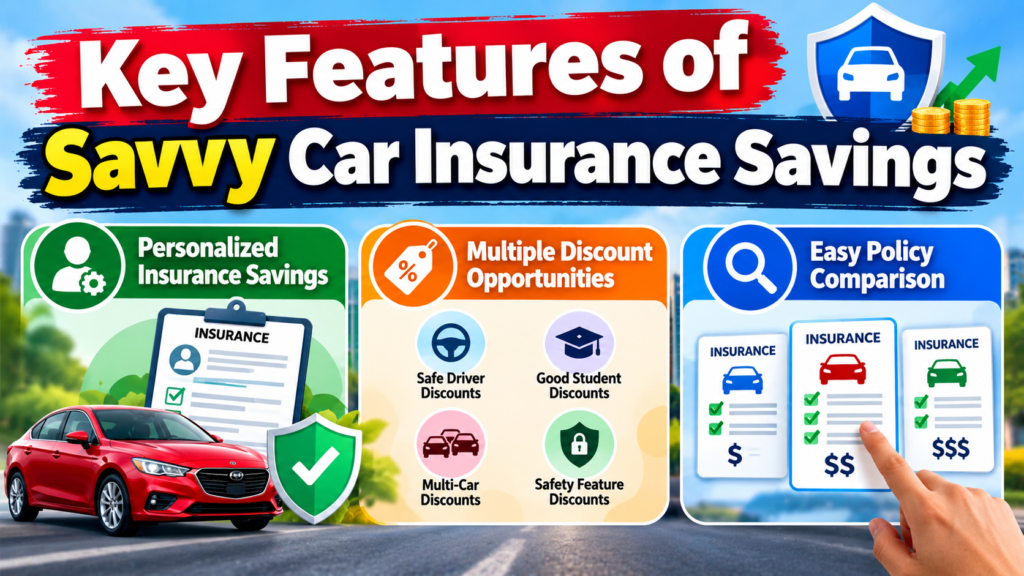
Key Features of Savvy Car Insurance Savings
- Personalized Insurance Savings – Helps drivers identify potential ways to reduce their car insurance premium based on their driving profile and coverage needs.
- Multiple Discount Opportunities – Can help users find savings through options such as safe-driver discounts, low-mileage discounts, multi-policy discounts, and vehicle safety discounts.
- Easy Policy Comparison – Encourages comparing car insurance quotes from different providers to find suitable coverage at a competitive price.
Compare Car Insurance Quotes Regularly
One of the simplest ways to search for savings is to compare quotes from multiple insurers. Prices can change as insurers update their pricing models, and your own circumstances may also change over time. When comparing quotes, make sure you provide the same basic information and request similar coverage limits and deductibles.
Compare Similar Coverage
A quote comparison is only useful when you are comparing similar products. If one policy has substantially lower liability limits or removes optional coverage, its lower price does not tell you much about its overall value.
Create a simple comparison showing:
Factor | What to Check |
Premium | Monthly and annual cost |
Liability | Coverage limits |
Collision | Deductible and covered losses |
Comprehensive | Deductible and covered losses |
Uninsured motorist | Limits and availability |
Roadside assistance | Included or optional |
Rental coverage | Limits and daily allowance |
Discounts | Eligibility and amount |
Claims service | Available support and process |
This approach makes the comparison more meaningful and reduces the chance of choosing a policy simply because one number looks smaller.
Ask About Available Discounts
Insurance discounts can make a noticeable difference, but they are not always automatically applied. Depending on the insurer and jurisdiction, discounts may be linked to safe driving, multiple policies, vehicle safety equipment, low mileage, defensive-driving courses, or other qualifying factors.
Common Discounts to Check
Instead of assuming you receive every available discount, ask your insurer to review your account. Your circumstances may have changed since you first purchased the policy.
Some commonly advertised discount categories include:
- Multi-policy discounts
- Safe-driver discounts
- Vehicle safety discounts
- Low-mileage discounts
- Good-student discounts, where available
- Defensive-driving discounts, where applicable
- Payment-related discounts, depending on the insurer
- Usage-based insurance programs
Eligibility rules vary, so always confirm the exact requirements with the insurer.
Compare Car Insurance Quotes Regularly
One of the simplest ways to improve car insurance savings is to compare quotes from different insurers. Insurance companies do not necessarily charge the same amount for the same driver and similar coverage. The NAIC specifically recommends comparison shopping because premiums and claims service can differ between companies.
When comparing car insurance quotes, avoid looking only at the headline premium. Check the liability limits, collision and comprehensive coverage, deductibles, exclusions, optional benefits, and available discounts. A quote that is $100 cheaper may not actually be a better value if it provides substantially less protection. The goal is to compare similar policies so you can see the genuine difference in price.
Compare Equal Coverage
A common mistake during insurance shopping is comparing two policies with different coverage levels. One insurer may quote a low premium because the deductible is higher or certain optional protections have been removed. Another company may appear more expensive because the quote contains broader coverage.
Create a simple comparison table containing the car insurance premium, liability limits, collision deductible, comprehensive deductible, roadside assistance, rental coverage, discounts, and other important features. The NAIC advises consumers to provide consistent information when requesting quotations so that comparisons are meaningful.
Build a Better Driving Record
Your driving history can affect insurance pricing. Tickets, accidents, and certain violations may influence premiums, depending on the insurer’s rating rules and the applicable laws. Over time, maintaining a clean driving record may help you qualify for better rates or safe-driving programs.

Safe driving also has a benefit that goes beyond insurance. Fewer accidents can mean fewer repair bills, fewer disruptions, and less time dealing with claims. Simple habits such as avoiding distractions, following speed limits, maintaining safe distances, and staying alert can support both road safety and long-term financial planning.
Why Safe Driving Can Help
Insurance is based partly on risk. Insurers use available information to estimate the likelihood and potential cost of future claims. A history of responsible driving can therefore be relevant when an insurer evaluates your risk.
However, there is no universal guarantee that a particular driving habit will produce a specific premium reduction. Each insurer uses its own rules, and state or national regulations can also affect pricing.
Avoid Paying for Unnecessary Coverage
More coverage is not automatically better for every driver. Some optional protections may be useful for one person and less useful for another. Your vehicle’s age, value, financing status, driving habits, and personal finances can all influence the decision.
Consider Your Vehicle's Age and Value
If you own an older vehicle, review whether every optional coverage still provides enough value to justify its cost. Collision and comprehensive coverage may be particularly worth reviewing as a vehicle becomes older, although the decision depends on the vehicle’s value, your financial position, and any lender requirements.
If your car is financed or leased, the lender may require certain coverage. You should confirm those requirements before removing or changing coverage.
The goal is not to remove protection blindly. It is to make sure the protection you purchase still matches your vehicle and circumstances.
Improve Your Credit Where Applicable
In some jurisdictions, insurers may use credit-based insurance information as one factor in pricing, while other jurisdictions restrict or prohibit certain uses of credit information. Because rules differ, check how insurance pricing works where you live.
Where permitted, maintaining healthy financial habits may help with more than insurance. Paying bills on time, keeping debt under control, and reviewing credit reports for errors are useful financial practices in their own right.
It is important to separate general financial improvement from guaranteed insurance savings. Better credit does not automatically mean a specific premium reduction because insurers use different rating models and other factors also affect pricing.
Bundle Insurance Policies
If you have more than one insurance policy, ask whether combining policies with the same insurer could reduce your overall cost. Bundling may be available for combinations such as auto and home or renters insurance, depending on the insurer and market.
Do not assume that bundling is automatically the cheapest option. Compare the total cost of all policies together against comparable options from other insurers. A discount on one policy can sometimes be outweighed by a higher base price on another.
The useful question is simple: What will I pay for the complete insurance package? Looking at the total helps prevent a small advertised discount from distracting you from the bigger financial picture.
Review Your Policy After Major Life Changes
Insurance should not be treated as a “set it and forget it” product. Your needs can change after moving, changing jobs, getting married, adding a driver, buying a different vehicle, retiring, or changing how often you drive.
A policy that made sense two years ago may not be the right fit today. Review your policy whenever a major change occurs instead of waiting until renewal.
For example, moving to a new location can change the risk factors used by an insurer. Similarly, adding a household driver can change the policy’s pricing and coverage needs. Promptly reporting important changes also helps keep your policy information accurate.
Understand Telematics and Usage-Based Insurance
Telematics programs use technology to collect driving information, with the driver’s permission and subject to the program’s terms. Depending on the insurer, the program may consider factors such as mileage, braking, acceleration, or driving times.
These programs can be useful for drivers who want their insurance pricing to reflect actual driving behavior. However, you should read the privacy terms and understand exactly what information is collected, how it is used, and whether participation can affect your premium.
Usage-based insurance is not automatically suitable for everyone. Before enrolling, look at the potential savings alongside the program requirements and data considerations.
When Should You Re-Shop for Insurance?
There is no single perfect date for every driver to compare car insurance. Renewal is a natural opportunity, but you can also compare options after significant changes to your vehicle, driving habits, household, or location.
Give yourself enough time to review the current policy before making a change. Check the new quote carefully and confirm that the coverage is comparable.
Avoid cancelling an existing policy before the replacement coverage is properly active. A gap in coverage can create serious financial and legal problems depending on where you live.
Conclusion
Getting more value from car insurance starts with understanding what you already have. Compare quotes, check discounts, review deductibles, keep your information accurate, and reassess coverage when your circumstances change. These simple habits can help you make more informed insurance decisions without automatically sacrificing useful protection.
The cheapest premium is not always the most useful policy, and the most expensive policy is not necessarily the right one either. A smarter approach is to compare the complete package: price, coverage, deductibles, benefits, and service. When you review these factors regularly, your insurance can stay better aligned with both your driving needs and your budget.
Frequently Asked Questions
Start by comparing quotes, checking available discounts, reviewing your deductible, and confirming that your coverage still matches your needs. Also ask your insurer whether your mileage, driving record, safety features, or multiple policies could qualify for savings.
No. A higher deductible may lower the premium for certain coverage, but it also means you may pay more out of pocket after a covered claim. Choose a deductible that fits your financial situation.
Review your policy at least around renewal time and whenever a major life or driving change occurs. Comparing options periodically can help you identify changes in pricing or available discounts.
It can, depending on the insurer and applicable rules. Some companies offer safe-driver or usage-based programs. Ask your insurer which programs are available and what requirements apply.
Price is only one factor. Compare the coverage limits, deductibles, exclusions, benefits, claims support, and overall policy terms before deciding which option fits your needs.
Table of Contents
Popular Posts

-
 Affordable Technical SEO Audit for Small Business: A Complete Guide26 Jun 2025 Blog
-
 How to Get an Affordable Technical SEO Audit for Small Business27 Jun 2025 Blog
-
 Local SEO Audit Checklist for Startups: A Beginner’s Guide28 Jun 2025 Blog
-
 The Ultimate Local SEO Audit Checklist for Startups28 Jun 2025 Blog
-
 Top On-Page SEO Audit Steps for Service Websites Every Business Should Know29 Jun 2025 Blog
-
 The Impact of On-Page SEO Audit Steps for Service Websites on UX01 Jul 2025 Blog
-
 Technical SEO for WordPress: The Ultimate Beginner’s Guide01 Jul 2025 Blog
-
 Technical Mobile SEO Audit Tips for Developers02 Jul 2025 Blog
Related Post