

Key Trends and Insights Shaping Uber Eats Global Delivery Today

Uber Eats has grown far beyond its original role as a food delivery app. Today, the platform is becoming a wider local commerce network where people can order meals, groceries, household products, beauty items, electronics, and other everyday goods. This shift is changing the way consumers think about delivery. Instead of asking whether they can order dinner through an app, people are increasingly asking a much bigger question: What can I get delivered right now?
The numbers show why this change matters. Uber reported that its Delivery Gross Bookings reached $25.43 billion in 2025, up from $20.13 billion in 2024. Delivery revenue also grew strongly during the year, while Delivery Adjusted EBITDA reached $3.6 billion. In 2026, Uber has continued to report strong growth, with Delivery Gross Bookings increasing 25% year over year in the second quarter. Grocery and retail are growing even faster than restaurant delivery, making them one of the most important parts of the company’s future strategy.
Table of Contents
The Global Growth of Uber Eats
Uber Eats has reached a scale where it is no longer simply a side business connected to Uber’s ride-hailing service. In its 2026 first-quarter remarks, Uber said Uber Eats operated in 35 countries, with strong international growth in markets such as Australia, Japan, and the UK. The company also said its global merchant base had reached about 1.4 million. This gives Uber Eats a large network of restaurants, stores, couriers, and customers that can support further growth.
One interesting part of this growth is that Uber can use its existing transportation network to enter new delivery markets. Instead of building a completely new logistics system from zero, it can use technology, local knowledge, drivers, couriers, and customer relationships already connected to Uber. This can make expansion more efficient. The company has also used this approach in newer markets, including Denmark, where Copenhagen passed 10,000 daily trips within its first month after launch.
Delivery is becoming a larger part of Uber
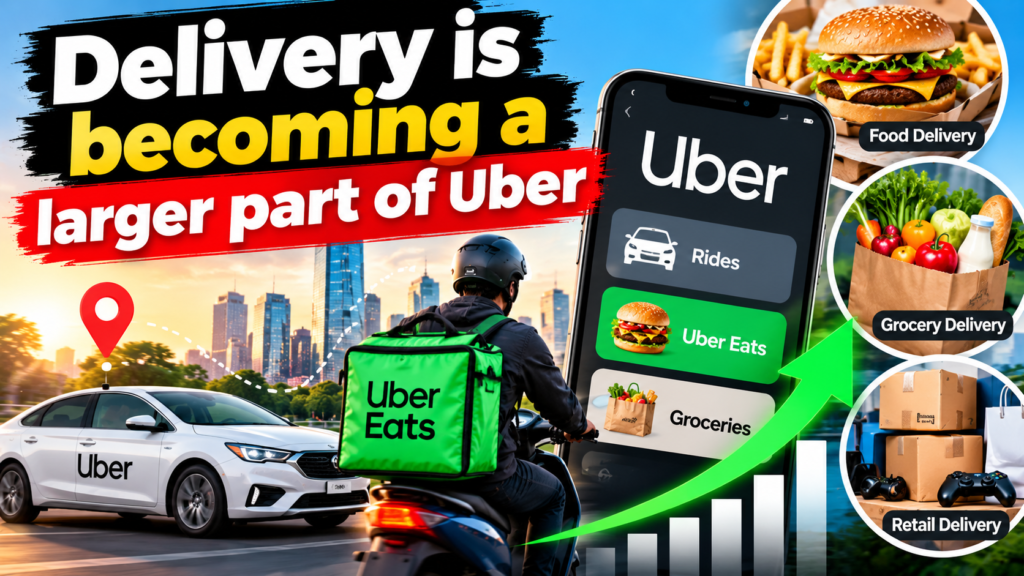
The growth of Delivery is important because it strengthens Uber as a broader consumer platform. A person may use Uber for a ride in the morning, order lunch through Uber Eats, buy groceries later, and use the same Uber One membership across these services.
Uber reported that around 58% of first-time Delivery consumers in the fourth quarter of 2025 were new to the Uber platform. The company also said customers using both Mobility and Delivery generated more than three times the Gross Bookings of users who used only one service in countries where both were available.
This creates a powerful network effect. More services can lead to more customer engagement, and more customer activity can make the platform more useful to merchants and delivery workers.
From Food Delivery to Local Commerce
The biggest strategic change may be the movement from food delivery to local commerce. Food remains central to Uber Eats, but the company is increasingly treating the platform as a way to access almost anything available nearby.
Uber’s second-quarter 2026 results show how quickly this area is developing. Uber reported that its Grocery & Retail segment had achieved approximately $15 billion in annualized Gross Bookings, with growth of around 40% year over year for several consecutive quarters. It also highlighted new partnerships involving brands such as Decathlon, GameStop, Kiehl’s, Tesco, Toys“R”Us, and Ulta Beauty.
This strategy makes sense from a consumer perspective. Imagine needing dinner ingredients, shampoo, a phone charger, pet supplies, or a last-minute gift. Traditionally, you would visit several websites or stores. A local commerce platform tries to put those needs inside one app.
That is a major change in the delivery industry. The competition is no longer only about who delivers the best pizza. It is increasingly about who can become the easiest way to access local products.
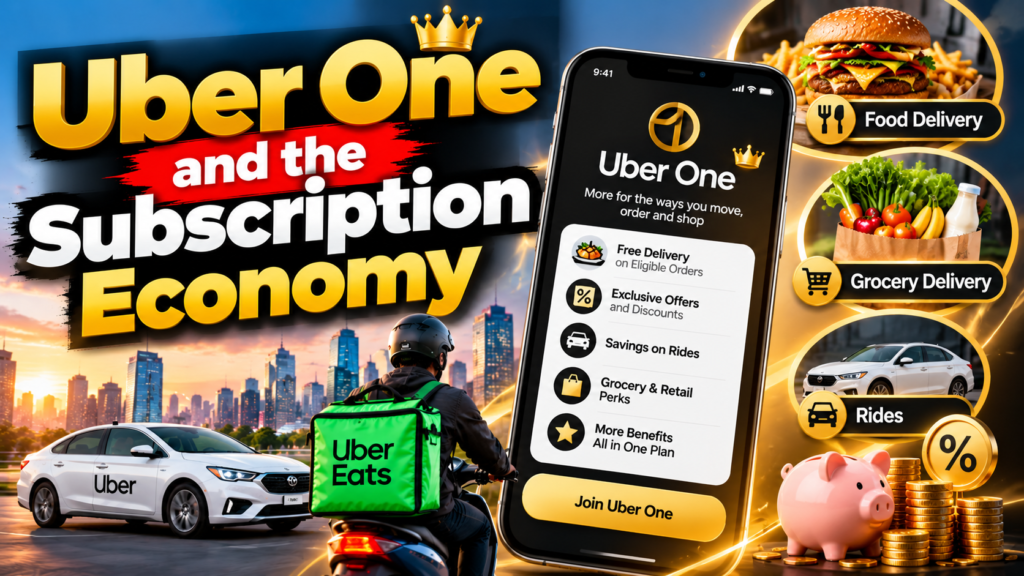
Uber One and the Subscription Economy
Another important trend is the growth of subscription-based delivery. Uber One combines benefits across rides, food delivery, grocery, and retail. As of December 2025, Uber said its Uber One membership base had reached 46 million members across more than 30 countries.
Why does membership matter? Consumers who pay for a subscription have a stronger reason to use the platform regularly. A customer may order more frequently because delivery fees or other costs are reduced. At the same time, Uber gets a more predictable relationship with that customer.
This creates a cycle: membership encourages usage, usage creates more data, more activity attracts merchants, and stronger merchant selection gives customers another reason to remain members.
For consumers, the value question remains important. If delivery fees are high, people may decide to cook at home or visit a store. Subscription programs can reduce that barrier and make delivery feel more like an everyday service instead of an occasional luxury.
The Rise of Grocery Delivery
Grocery delivery has become one of the strongest growth areas for Uber Eats. Consumers are increasingly comfortable ordering everyday food items online, especially when they need convenience, flexible delivery times, or quick access to products.
Uber has continued adding major grocery partners. In September 2026, Uber Eats announced that more than 375 Wakefern stores had joined its marketplace across the U.S. Northeast, including ShopRite and several other supermarket brands. Customers can order fresh produce, meat, seafood, pantry products, prepared foods, and household essentials through the app.
Earlier in 2026, nearly 2,000 stores operated by Ahold Delhaize USA brands became available on Uber Eats for on-demand grocery delivery. These partnerships show that Uber is building a much larger grocery network instead of treating grocery as a small addition to restaurant delivery.
The challenge is that grocery shopping is more complex than ordering a prepared meal. Products may be out of stock, sold by weight, substituted, or damaged. Uber has therefore invested in features such as better substitutions, inventory tools, barcode scanning, product images, and real-time support.
This means the future of grocery delivery will depend not only on speed but also on accuracy and reliability.
Faster Delivery and Quick Commerce
Speed has become one of the defining expectations in modern delivery. Customers increasingly want food and products delivered quickly, but they also want accurate arrival times and reliable service.
This has helped create the quick commerce model, where products are delivered in a very short period. Uber has shown increasing interest in this market because grocery and retail orders can create new occasions beyond normal meal times.
The company has also highlighted the idea that quick commerce could become a major growth opportunity. In 2026, Uber’s partnership with Zipline focused on drone deliveries that could potentially reach customers within minutes. TechCrunch reported that Uber and Zipline are targeting one million drone deliveries per day by the end of 2029.
Speed is becoming a key customer expectation
Consumers have become accustomed to real-time information. They can see when an order is accepted, when a courier is approaching a restaurant, and when the package is close to their door.
That visibility changes expectations. People do not simply want fast delivery; they want to know what is happening during the entire journey. Better tracking, accurate estimated arrival times, and proactive notifications can reduce uncertainty.
For Uber Eats, this makes logistics technology just as important as the app itself.
AI and Smarter Delivery Operations
Artificial intelligence is becoming another important part of the delivery business. Delivery platforms handle huge amounts of information every minute, including order demand, restaurant preparation time, courier locations, traffic, customer preferences, product availability, and estimated delivery times.
AI can help turn this information into better decisions. Uber has said it is testing first-party AI agents for both customers and drivers or couriers. The company has also described an AI Assistant designed to help drivers and couriers plan their day and improve earnings.
For customers, AI could make food and product discovery easier. Instead of searching through hundreds of restaurants, a customer might describe what they want and receive a short list of suitable choices.
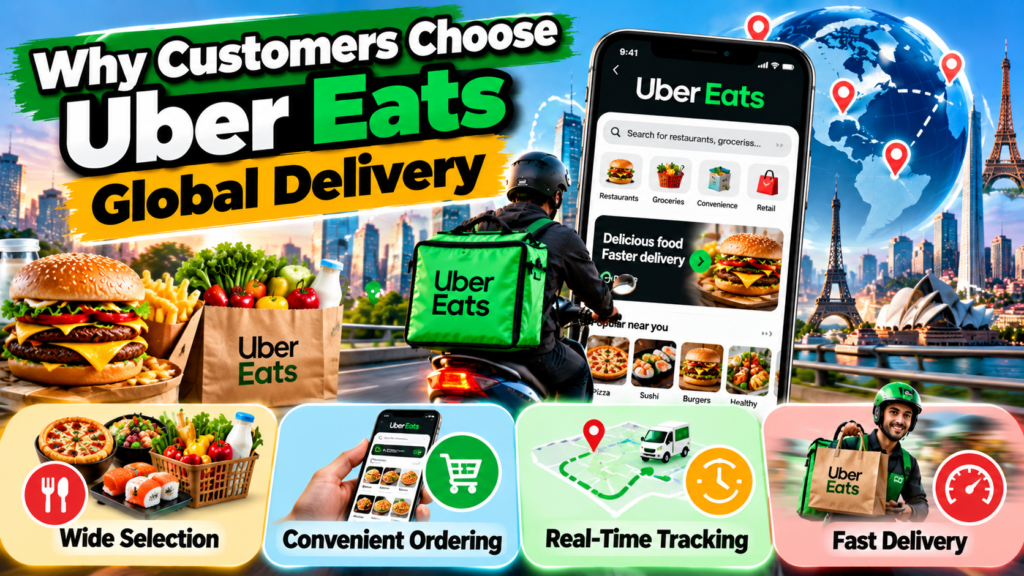
Why Customers Choose Uber Eats Global Delivery
- Wide Selection: Customers can access thousands of restaurants, grocery stores, and retail businesses through one platform.
- Convenient Ordering: Users can browse menus, compare options, place orders, and track deliveries directly from the app.
- Real-Time Tracking: Customers can follow their order and see estimated delivery times.
- Fast Delivery: Uber Eats uses a large delivery network to provide quick and flexible delivery options.
Autonomous Delivery and Drones
Autonomous delivery is moving from an experimental idea toward a more visible part of the delivery industry. Uber is pursuing a hybrid model that can combine human couriers, sidewalk robots, autonomous vehicles, and drones.
One of the clearest recent examples is the partnership between Uber and Zipline. Announced in August 2026, the companies said they plan to begin Uber Eats drone deliveries later in the year and target one million drone deliveries per day by the end of 2029.
The attraction is easy to understand. Drones can potentially avoid road traffic and deliver small orders quickly. They could be useful for short-distance grocery orders, meals, medicine-related retail products where legally permitted, and other lightweight goods.
Uber's partnership with Zipline
Uber’s strategy is interesting because it does not require the company to build every delivery technology itself. Instead, Uber can provide the marketplace and customer network while technology partners provide specialized delivery systems.
This approach could make the delivery network more flexible. A human courier may be best for one order, while a robot or drone may be better for another.
The long-term goal is therefore not necessarily a world without human couriers. It is more likely to be a hybrid delivery network where different methods are selected according to distance, cost, product type, traffic, weather, and customer needs.
Growth of Uber Eats Advertising
brands do not only want to sell products through Uber Eats; they also want their products to be discovered.
Uber has built advertising products around this demand. In its fourth-quarter 2025 remarks, the company said annualized advertising revenue had passed $2 billion, growing more than 50% year over year. Delivery advertising as a share of Delivery Gross Bookings also passed 2%, supported by Sponsored Listings and Sponsored Items.
This creates a new revenue stream that does not depend entirely on delivery fees or commissions.
For brands, the appeal is clear. Advertising inside a delivery app can reach consumers close to the point of purchase. A restaurant can promote a meal when someone is hungry. A grocery brand can promote a product when someone is already shopping.
Also Read
Exploring Timeless Clothing Designs and Quality Materials at Gentle Herd
What Makes Liveit.se a Useful Platform for Finding New Experiences
The Ultimate Guide to Der Gepflegte Mann Grooming Products
A Complete Guide to Understanding T&S Clothing, LLC and Its Clothing Business
The Ultimate Guide to Finding Relaxation and Adventure at the Shore
Merchant Partnerships and Wider Selection
Selection is one of the strongest drivers of marketplace growth. If customers cannot find what they need, they have little reason to open an app.
Uber has therefore continued to add restaurants, supermarkets, retailers, and specialist brands. The expansion into retail categories makes Uber Eats more useful throughout the day.
Recent partnerships demonstrate this strategy. Uber has expanded grocery access through Wakefern and Ahold Delhaize while also highlighting retail partnerships with brands across fashion, beauty, toys, sports, and electronics.
Global Expansion and Local Market Strategy
Uber Eats is global, but delivery remains strongly local. Food preferences, regulations, payment habits, restaurant types, traffic conditions, and consumer expectations differ from one country to another.
That means Uber cannot simply copy one model everywhere. A strategy that works in the United States may need changes in India, Japan, Australia, Mexico, or Europe.
Uber’s recent results show that international markets remain important. In the first quarter of 2026, the company highlighted Australia, Japan, and the UK as strong areas of international growth.
Consumer Behavior Is Changing
The modern delivery customer is not necessarily ordering only for dinner. People order around work, fitness, social activities, travel, family routines, and unexpected needs.
Uber’s recent Australian research described delivery as fitting around changing lifestyles, including orders between meetings, post-workout purchases, afternoon snacks, and late-night cravings.
Social media is also influencing food discovery. A dish can become popular in one country and quickly attract attention somewhere else. This makes delivery platforms part of the broader digital culture around food.
Limited-time products, celebrity collaborations, viral dishes, sports events, and entertainment trends can all create sudden demand.
Sustainability and New Delivery Models
Sustainability is becoming more relevant as delivery volumes grow. More orders can mean more vehicle trips, packaging, and energy use.
Autonomous delivery methods may offer some advantages depending on how they are deployed. Uber and Zipline, for example, highlight the potential for drone delivery to reduce traffic and emissions.
But sustainability is not automatically guaranteed. The environmental impact depends on the vehicle or drone, energy source, delivery distance, order density, packaging, and whether autonomous systems replace or simply add to existing trips.
Competition in the Global Delivery Market
Uber Eats operates in a highly competitive market. Customers can choose among multiple food delivery apps, restaurant websites, grocery platforms, and direct retailer services.
Competition is increasingly moving beyond restaurant selection. Companies are competing on membership programs, grocery selection, delivery speed, retail partnerships, advertising, autonomous delivery, and merchant services.
Recent moves by companies such as Deliveroo also show that robotics and grocery delivery are becoming competitive areas across the industry. Deliveroo is preparing to expand food delivery robots in several UK cities, showing that automation is becoming a wider industry trend rather than something unique to Uber.
What Comes Next for Uber Eats
The next phase of Uber Eats will probably be defined by the combination of several trends rather than one major invention.
Food delivery will remain important, but grocery and retail are likely to become increasingly central. AI will help improve discovery and operations. Advertising will become a larger part of the business. Uber One will continue connecting different services through membership.
Autonomous delivery could also become more visible. Uber’s Zipline partnership provides a clear example, with the companies targeting one million drone deliveries per day by 2029.
The most interesting possibility is the development of a hybrid delivery network. Human couriers, cars, bikes, robots, drones, and other technologies could work together depending on the order.
If Uber can make this network affordable and reliable, Uber Eats could become less like a food-ordering app and more like a digital gateway to local commerce.
Conclusion
The global delivery industry is changing quickly, and Uber Eats is moving with it. The platform’s growth is no longer based only on delivering restaurant meals. Grocery, retail, subscriptions, advertising, AI, merchant services, and autonomous delivery are becoming important pieces of the larger strategy.
Uber’s recent results show strong momentum. Delivery Gross Bookings grew 22% in 2025, while the second quarter of 2026 brought another 25% year-over-year increase. Grocery and Retail reached about $15 billion in annualized Gross Bookings and continued to grow faster than restaurant delivery.
The biggest insight is that delivery is becoming a broader local commerce service. Consumers increasingly expect products to come to them quickly, reliably, and at a reasonable price. Businesses want access to customers without building every part of the delivery system themselves.
Frequently Asked Questions
The major trends include grocery and retail expansion, faster delivery, Uber One memberships, AI, advertising, merchant partnerships, and autonomous delivery. Uber is increasingly positioning Eats as a local commerce platform rather than only a restaurant delivery service. Grocery and retail are currently among the fastest-growing areas of the business.
Yes. Uber Eats is expanding into groceries, household essentials, beauty, electronics, toys, fashion, and other retail categories. The company has recently expanded partnerships with major grocery and retail businesses and is focused on making more local products available through its platform.
AI can help with product discovery, customer support, delivery planning, demand forecasting, and marketplace efficiency. Uber has said it is developing consumer-facing AI agents and an AI Assistant for drivers and couriers.
Yes. Uber has partnered with Zipline to bring autonomous drone delivery to Uber Eats. The companies announced plans for initial deliveries later in 2026 and are targeting one million drone deliveries per day by the end of 2029.
The future is likely to combine food, grocery, retail, subscriptions, advertising, AI, and multiple delivery technologies. Rather than relying on one delivery method, Uber is building a flexible network that can use human couriers, autonomous systems, and drones depending on the order and location.
Table of Contents
Popular Posts

-
 Affordable Technical SEO Audit for Small Business: A Complete Guide26 Jun 2025 Blog
-
 How to Get an Affordable Technical SEO Audit for Small Business27 Jun 2025 Blog
-
 Local SEO Audit Checklist for Startups: A Beginner’s Guide28 Jun 2025 Blog
-
 The Ultimate Local SEO Audit Checklist for Startups28 Jun 2025 Blog
-
 Top On-Page SEO Audit Steps for Service Websites Every Business Should Know29 Jun 2025 Blog
-
 The Impact of On-Page SEO Audit Steps for Service Websites on UX01 Jul 2025 Blog
-
 Technical SEO for WordPress: The Ultimate Beginner’s Guide01 Jul 2025 Blog
-
 Technical Mobile SEO Audit Tips for Developers02 Jul 2025 Blog
Related Post