
ITEAD Buying Guide: Best Devices, Features, and Expert Tips

Looking for the best smart home automation solutions? This ITEAD Buying Guide covers the best ITEAD devices, key features, pricing, pros and cons, and expert buying tips to help you choose the right smart switches, sensors, and automation products for your home. Whether you’re a beginner or an experienced smart home enthusiast, this guide provides everything you need to make an informed decision.
Table of Contents
Understanding the ITEAD Ecosystem
When people first discover ITEAD, they often assume it is simply another smart home brand selling Wi-Fi switches and sensors. The reality is much bigger. ITEAD has built an ecosystem that spans smart homes, industrial displays, and software-defined radio technology. The company operates several major product families including SONOFF smart home devices, Nextion HMI displays, and Airspy SDR receivers. According to the company’s official information, these brands collectively target consumers, hobbyists, industrial developers, and automation enthusiasts around the world.
Why ITEAD Has Become a Favorite Among Smart Home Enthusiasts
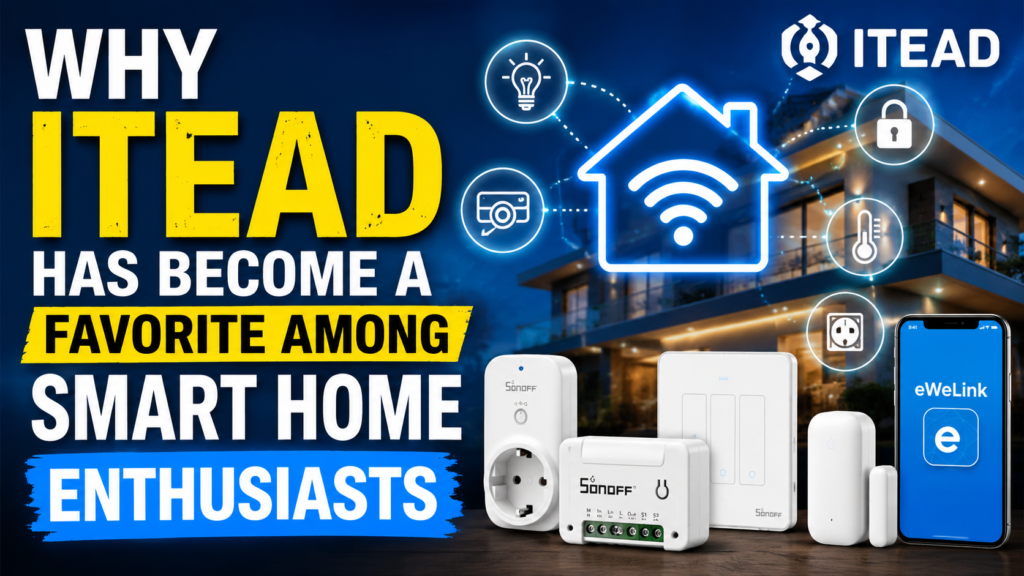

Price is one reason for ITEAD’s popularity, but affordability alone does not explain the loyal following the company enjoys among DIY users and professional installers. The real attraction comes from flexibility. Most ITEAD products support multiple ecosystems including Amazon Alexa, Google Home, Apple Home, and Home Assistant.
Another major advantage is community support. Search any smart home forum and you will find thousands of users discussing custom firmware, advanced automations, and local integrations involving SONOFF hardware. This strong community significantly extends the lifespan of devices because users often create solutions long after official support ends.
ITEAD has also invested heavily in interoperability technologies such as Matter and Zigbee. Recent product releases increasingly focus on allowing devices to communicate across ecosystems instead of locking users into one application or cloud platform. That strategy reflects where the entire smart home industry is heading today.
SONOFF Devices Explained
SONOFF is easily ITEAD’s most recognizable brand. If you’ve ever searched for smart switches online, chances are you’ve encountered a SONOFF product.
Smart Switches
Smart switches remain the backbone of most smart homes. Models such as the Basic series, MINI series, and ZBMINI lineup allow users to automate lights, fans, water pumps, and numerous appliances.
The biggest decision here involves installation style. Some switches replace existing wall switches entirely, while others hide behind traditional switches and preserve manual control. The hidden-module approach has become particularly popular because family members can continue using familiar switches without learning smartphone apps.
Smart Plugs
Smart plugs are often underestimated. Many buyers focus immediately on switches and sensors while ignoring the incredible flexibility offered by plug-based automation.
A smart plug can transform ordinary appliances into connected devices in seconds. Coffee makers can start before you wake up, water heaters can run only during off-peak electricity hours, and energy monitoring can reveal hidden power consumption.
Sensors and Automation Devices
Sensors are where smart homes become truly intelligent rather than merely remote-controlled.
Temperature sensors can trigger air conditioning automatically. Motion sensors can activate lights only when rooms are occupied. Presence sensors can distinguish between empty rooms and occupied spaces more accurately than traditional PIR technology.
Popular devices include temperature sensors, motion detectors, door sensors, and human presence sensors. The latest gateways support hundreds of connected devices simultaneously, making large-scale automation increasingly practical for average households.
Key Features of ITEAD
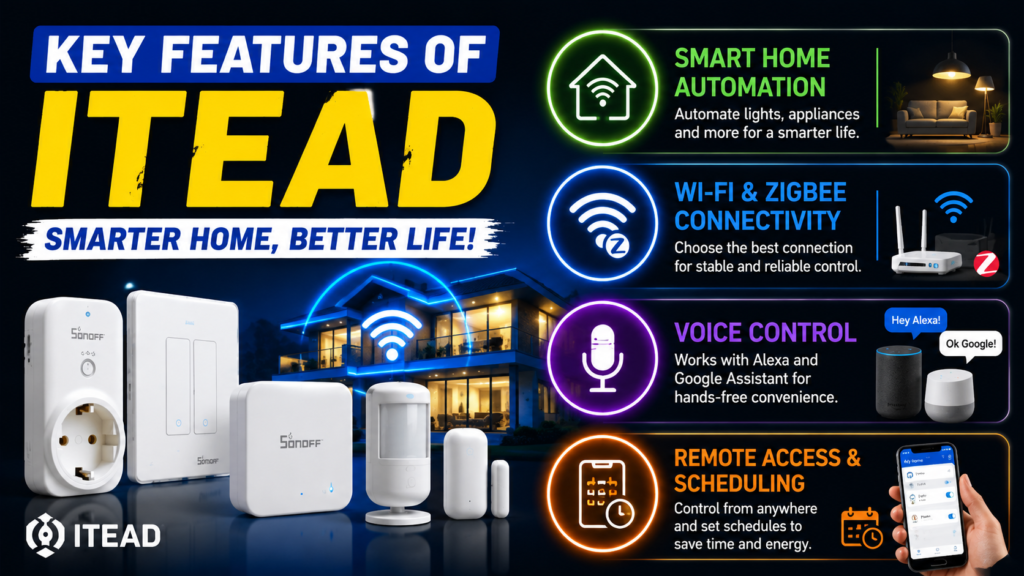
Smart Home Automation
Automate lights, appliances, and other devices to make your home smarter, more convenient, and energy-efficient.
Wi-Fi & Zigbee Connectivity
Choose between Wi-Fi for easy setup or Zigbee for a faster, more reliable smart home network.
Voice Control
Control your smart devices hands-free using Amazon Alexa or Google Assistant for added convenience.
Remote Access & Scheduling
Manage your devices from anywhere with the eWeLink app and create schedules or timers to automate daily tasks.
Nextion Displays for DIY Projects
While SONOFF dominates consumer attention, Nextion products quietly power thousands of industrial and hobbyist projects.
Basic Series
The Basic Series targets beginners and small projects. These displays are inexpensive, simple to program, and ideal for learning HMI development.
Arduino users frequently choose Basic displays because they eliminate much of the graphical programming complexity associated with traditional LCD interfaces. Instead of writing extensive code for buttons and graphics, developers can use drag-and-drop design tools.
Enhanced Series
Enhanced Series displays introduce additional processing power, larger storage capacity, and expanded hardware capabilities.
These displays are particularly attractive for industrial monitoring systems, smart agriculture projects, and manufacturing dashboards where reliability matters more than flashy graphics.
The extra hardware features often justify the price increase because they reduce external component requirements.
Intelligent Series
Intelligent Series displays target professional developers and industrial environments.
These products support advanced graphical interfaces and larger screen sizes. They are commonly found in medical equipment, industrial control systems, and commercial automation projects where interface quality directly affects usability.
For professionals building products for customers rather than personal projects, this series often provides the best long-term value.
Airspy SDR Devices
Airspy products occupy a completely different market segment, yet they remain an important part of ITEAD’s portfolio.
Software-defined radio technology allows users to receive and analyze radio signals using software rather than dedicated hardware circuitry. It sounds complicated, but modern SDR software makes the experience surprisingly accessible.
Applications include aviation monitoring, weather satellite reception, amateur radio, emergency communication monitoring, and scientific research. Enthusiasts often compare SDR exploration to fishing because you never know what interesting signals you might discover next.
ITEAD describes Airspy products as high-performance SDR receivers that combine affordability with advanced DSP and RF technologies.
Who Should Buy Airspy Products?
Airspy products are ideal for:
User Type | Recommendation |
Radio hobbyists | Excellent choice |
Amateur radio operators | Highly recommended |
Cybersecurity researchers | Useful |
General smart home users | Usually unnecessary |
Industrial RF engineers | Valuable tool |
Most homeowners will never need an SDR receiver, but enthusiasts interested in wireless technologies often become passionate advocates once they start experimenting.
Best ITEAD Devices for Beginners
New users should resist the temptation to automate everything immediately.
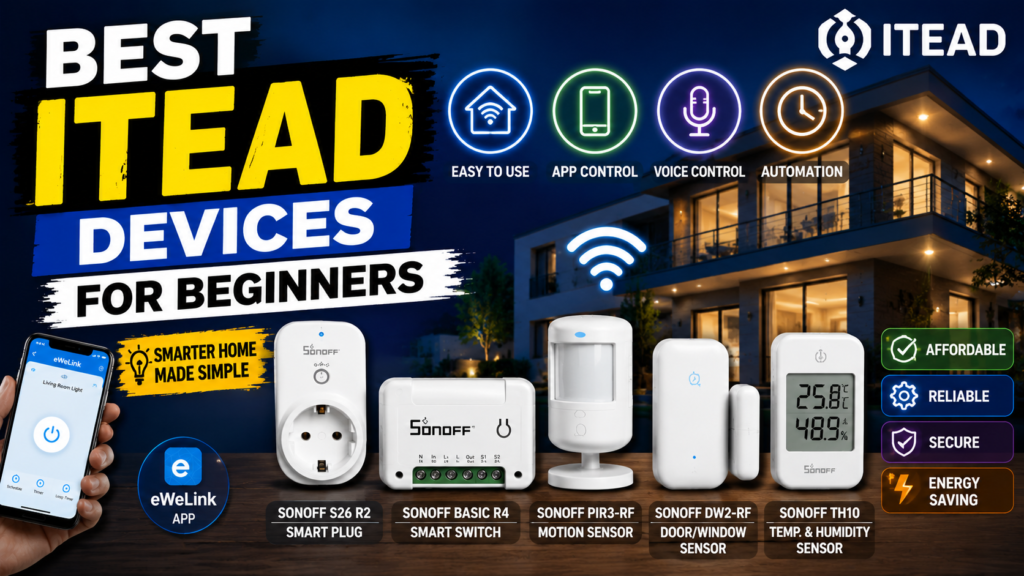
A practical starter setup often includes:
- One smart plug.
- One smart switch.
- One motion sensor.
- One gateway if choosing Zigbee.
This small ecosystem allows experimentation without major financial commitments.
Choosing Between Wi-Fi, Zigbee, and Matter
This decision affects every future purchase you make.
Wi-Fi Advantages
Wi-Fi devices are simple. Most homes already have routers, which means no additional hubs are necessary.
Installation usually involves scanning a QR code and entering network credentials. That simplicity explains why Wi-Fi products remain popular among beginners.
The downside is scalability. A house filled with fifty Wi-Fi devices can place significant load on consumer routers.
Zigbee Advantages
Zigbee devices create mesh networks. Every powered device extends network coverage, improving reliability as more devices are added.
Many advanced users consider Zigbee the gold standard for sensors and battery-powered devices because of low energy consumption and excellent stability.
Community experiences continue to show strong reliability advantages for Zigbee in larger installations.
Matter Advantages
Matter promises universal compatibility. A Matter-certified device should theoretically work with Apple Home, Google Home, SmartThings, and Alexa simultaneously.
The industry remains committed to Matter despite ongoing growing pains and implementation inconsistencies. More than 1,200 certified Matter products are now available globally.
For buyers starting fresh in 2026, Matter support increasingly represents a valuable future-proofing feature.
Best Devices for Advanced Users
Advanced users usually prioritize local control, protocol diversity, and platform independence.
The SONOFF iHost hub has become increasingly attractive because it supports local operation and Matter integration capabilities. Recent updates expanded backup features, device management capabilities, and Matter support.
The Zigbee Bridge Ultra represents another strong option for users planning large Zigbee deployments. Support for Ethernet connectivity improves reliability compared with purely Wi-Fi gateways, while Matter bridging expands ecosystem compatibility. The gateway supports up to 256 connected Zigbee devices.
Home Assistant enthusiasts frequently combine these products to create highly customized smart homes with minimal cloud dependence.
Also Read
Ledger US Explained: Features, Benefits, and Getting Started Guide
Superdry (UK) Sale Guide: How to Save More on Every Purchase
Vevor Kitchen Setup Ideas: Build a Smart Cooking Space in 2026
Top Reasons Tea Enthusiasts Prefer TEALEAVES for Gourmet Tea Blends
SlumberPod Review 2026: Is It the Ultimate Sleep Solution for Traveling Families?
Local Control and Privacy Considerations
Cloud dependence remains one of the largest concerns in modern smart homes.
What happens if internet connectivity fails? What if a company shuts down servers? What if privacy regulations change?
ITEAD has gradually responded to these concerns by expanding local control options through eWeLink CUBE OS and Matter bridges. Users can now operate many devices entirely within local networks without relying on external servers.
For privacy-conscious users, this development may be more important than any new sensor or switch release.
A smart home should continue functioning during internet outages. Local control ensures exactly that.
Budget Planning Before Buying
Smart homes rarely stay within initial budgets.
Many users begin with a single smart bulb and eventually discover themselves automating curtains, irrigation systems, garage doors, and energy monitoring systems.
Setting a clear budget avoids impulse purchases and protocol fragmentation.
Budget Range | Recommended Setup |
Under $50 | Smart plug and switch |
$50-$150 | Basic Zigbee starter kit |
$150-$300 | Hub, sensors, plugs, switches |
$300+ | Full home automation ecosystem |
Planning around expansion is equally important. Buying slightly more capable hardware today often saves money later.
Common Mistakes Buyers Make
The biggest mistake is mixing incompatible ecosystems without planning.
Another common error involves choosing Wi-Fi for every device simply because installation appears easier. Large Wi-Fi deployments frequently create network congestion and management headaches.
Ignoring neutral wire requirements is another expensive lesson. Many in-wall switches require neutral wiring while others specifically support no-neutral installations.
Buyers also underestimate the importance of gateway placement. A poorly positioned hub can create dead zones that appear to be device failures.
A little planning upfront prevents a surprising amount of frustration later.
Expert Buying Tips
If you remember only five things from this guide, remember these:
- Choose your primary protocol before buying anything.
- Prioritize local control whenever possible.
- Leave room for future expansion.
- Buy from product families with active communities.
- Avoid overcomplicating your first setup.
Smart homes are marathons rather than sprints. The best systems evolve gradually over months or years.
The current direction of the industry clearly favors interoperability, Matter support, and local processing. Buyers who align purchases with these trends will likely enjoy longer product lifespans and easier upgrades in the future.
Conclusion
ITEAD occupies a unique position in the technology market because it serves homeowners, makers, engineers, and radio enthusiasts simultaneously. Whether you’re searching for affordable smart switches, industrial touch displays, or advanced SDR hardware, the ecosystem offers compelling options.
For most consumers, SONOFF products will represent the ideal starting point thanks to their balance of affordability, reliability, and ecosystem flexibility. Advanced users can explore local hubs, Matter bridges, and Zigbee networks to build sophisticated automation systems that rival professional installations.
The smartest purchase is rarely the most expensive device on the shelf. It is the device that fits your ecosystem strategy, supports your long-term goals, and grows alongside your projects.
Frequently Asked Questions
No. SONOFF is one of several brands owned and operated within the broader ITEAD ecosystem.
Many newer devices support Matter or can be bridged into Apple Home environments through supported hubs.
Wi-Fi is easier initially, while Zigbee generally scales better for larger installations.
Matter continues to improve rapidly, although some interoperability limitations still exist in 2026.
For most users, a SONOFF smart switch or smart plug provides the best balance of price, features, and ease of use.
Table of Contents
Popular Posts

-
 Affordable Technical SEO Audit for Small Business: A Complete Guide26 Jun 2025 Blog
 -
 How to Get an Affordable Technical SEO Audit for Small Business27 Jun 2025 Blog
 -
 The Ultimate Local SEO Audit Checklist for Startups28 Jun 2025 Blog
 -
 Local SEO Audit Checklist for Startups: A Beginner’s Guide28 Jun 2025 Blog
 -
 Top On-Page SEO Audit Steps for Service Websites Every Business Should Know29 Jun 2025 Blog
 -
 The Impact of On-Page SEO Audit Steps for Service Websites on UX01 Jul 2025 Blog
 -
 Technical SEO for WordPress: The Ultimate Beginner’s Guide01 Jul 2025 Blog
 -
 Technical Mobile SEO Audit Tips for Developers02 Jul 2025 Blog
Related Post