

Direct Ferries: Travel Aggregator Marketing Strategy Breakdown

Discover how Direct Ferries became a global leader in ferry ticket comparison through smart digital marketing strategies. This article breaks down the Direct Ferries marketing approach, including SEO tactics, route-based content strategy, partnerships, and performance marketing that help the platform attract millions of travelers worldwide. Learn how this travel aggregator uses technology, localization, and marketplace economics to dominate ferry booking searches and scale its global presence.
Table of Contents
Understanding Direct Ferries as a Travel Aggregator
What Direct Ferries Does
At its core, Direct Ferries functions as a global travel aggregator that allows users to compare and book ferry tickets from multiple operators in one place. Rather than owning ships or operating ferry routes, the company acts as an intermediary platform that connects travelers with ferry companies across the world. The concept is similar to how flight comparison platforms like Skyscanner or hotel booking platforms like Booking.com work. Travelers simply enter their departure port, destination, and travel date, and the platform displays available routes, prices, and schedules from multiple ferry operators.
This comparison-driven approach dramatically simplifies ferry travel planning. Ferry schedules and pricing structures can be complicated because each operator runs independent routes with different policies, timetables, and pricing tiers. Without an aggregator, travelers would need to visit several websites to compare options manually. Direct Ferries solves this pain point by centralizing data from hundreds of operators and displaying it in a single interface. That simple convenience is the foundation of the company’s marketing and growth strategy.
The platform’s positioning is also clever. Instead of selling ferry travel directly, it sells choice, convenience, and transparency. When users visit the site, they immediately see multiple operators competing on price and availability. That comparison creates a powerful psychological trigger: customers feel confident they are getting the best option available.
Scale of the Platform and Global Reach
One of the reasons Direct Ferries has become such a powerful travel aggregator is its sheer scale. The platform aggregates ferry routes, schedules, and pricing from more than 250 ferry operators worldwide, offering thousands of routes across many countries.
According to available data, the company offers over 3,000 ferry crossings worldwide, connecting hundreds of ports across continents. The platform supports routes throughout Europe, Africa, Asia, North America, and other global regions, making it one of the largest ferry booking marketplaces in the world.
The reach of Direct Ferries is significant because ferry travel is traditionally fragmented. Unlike airlines, which operate within large global alliances, ferry companies typically operate regionally. By aggregating these fragmented services into a single booking platform, Direct Ferries effectively creates a global distribution system for ferry travel.
From a marketing perspective, scale is everything. The more routes, ports, and operators the platform lists, the more search queries it can capture. Someone searching for “ferry from Dover to Calais” or “ferry Greece island routes” will likely encounter Direct Ferries in search results because the company has optimized thousands of pages around these route-based queries.
Core Business Model Behind Direct Ferries
Aggregator Marketplace Model Explained
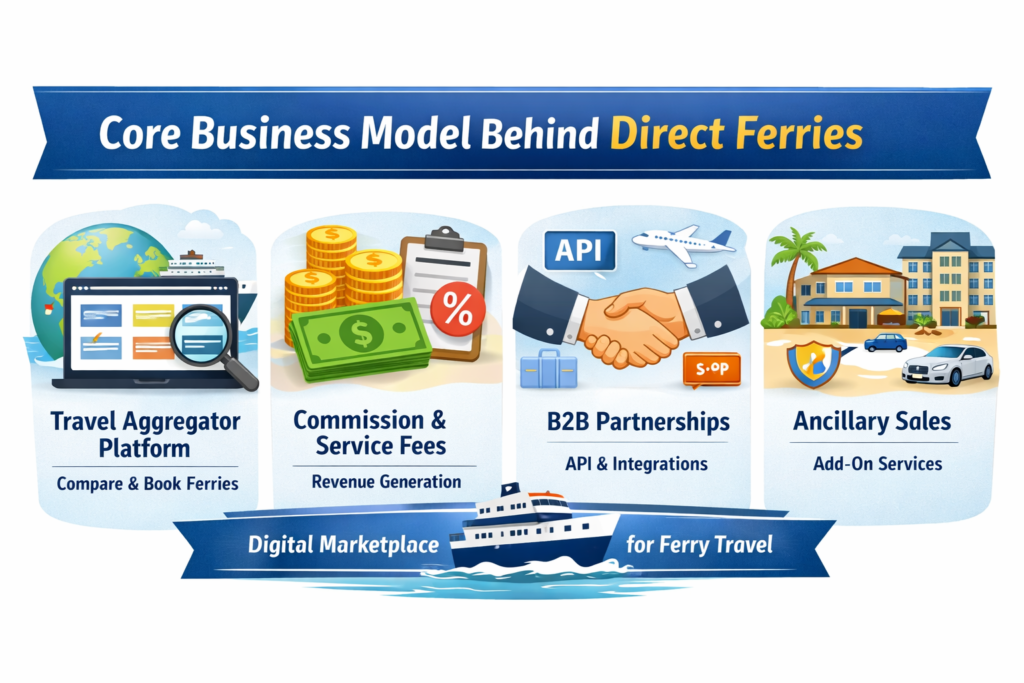

The business model behind Direct Ferries is a classic travel aggregator marketplace model. The platform collects route information, schedules, and prices from ferry operators and presents them in a searchable interface for users. When a traveler books a ticket through the platform, Direct Ferries receives a commission or service fee.
This model offers several advantages. First, it allows the company to scale quickly without owning transportation assets. Building a fleet of ferries would require billions of dollars in capital investment, but operating a digital marketplace requires far less infrastructure.
Second, the aggregator model benefits from strong network effects. The more operators that join the platform, the more attractive it becomes for travelers. And the more travelers use the platform, the more operators want to be listed. This positive feedback loop strengthens the marketplace over time.
Third, the platform’s neutral position creates trust among consumers. Travelers often assume that booking directly through an operator will give them the best price. However, a comparison platform demonstrates multiple options at once, increasing confidence in the final purchase decision.
Revenue Streams and Monetization Strategy
Direct Ferries generates revenue from several sources, which together create a diversified income stream.
Revenue Source | Description |
Commission from ferry operators | Percentage of each ticket sale |
Service fees | Booking and processing charges |
Ancillary travel products | Accommodation, insurance, and add-ons |
B2B integrations | API access for travel platforms |
The company’s estimated annual revenue is around $40.1 million, demonstrating the profitability of the aggregator model even with a relatively small team.
The ability to monetize both B2C bookings and B2B partnerships makes the business particularly resilient. Even if consumer demand fluctuates seasonally, API integrations with travel platforms continue generating revenue.
SEO Strategy That Drives Massive Traffic
Route-Based SEO and Long-Tail Keywords
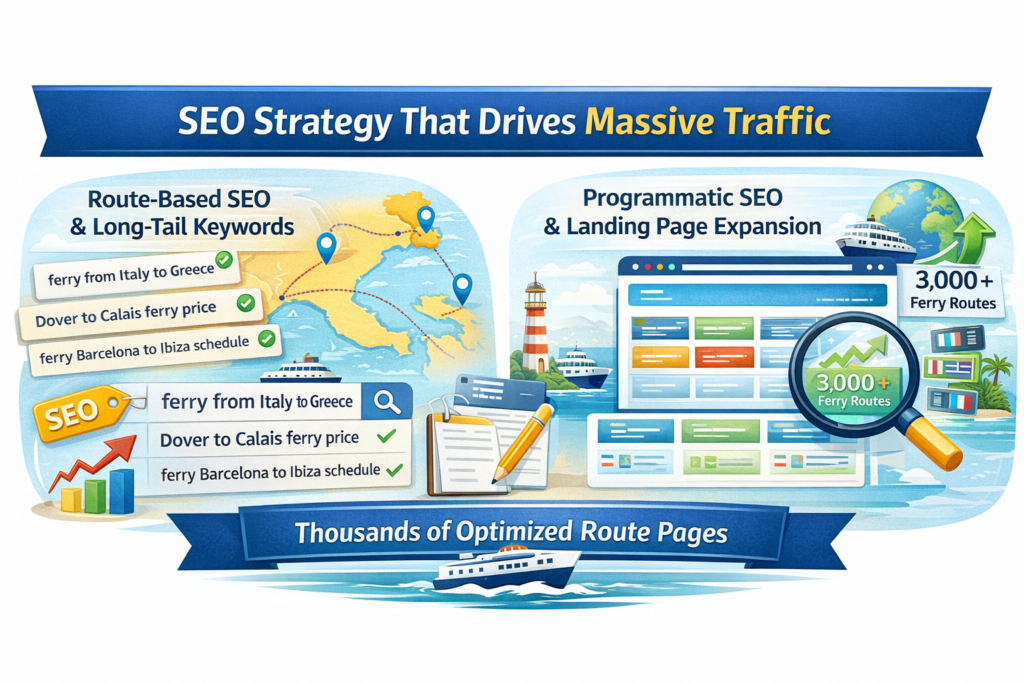
One of the most powerful growth engines for Direct Ferries is its SEO strategy. The company targets thousands of route-specific keywords that travelers search when planning trips. Examples include phrases like “ferry from Italy to Greece,” “Dover to Calais ferry price,” or “ferry Barcelona to Ibiza schedule.”
These keywords may not individually attract huge search volumes, but collectively they create massive organic traffic potential. This approach is known as long-tail SEO, where websites rank for thousands of niche queries rather than a handful of broad keywords.
Each ferry route typically has its own dedicated landing page containing:
- route schedules
- ticket prices
- operator comparisons
- travel tips
- booking options
Because the pages provide detailed information specific to each route, they rank well in search results. When multiplied across thousands of routes, this strategy becomes incredibly powerful.
Programmatic SEO and Landing Page Expansion
Direct Ferries also relies heavily on programmatic SEO, a strategy where thousands of pages are generated automatically using structured data. Ferry route data is perfect for this approach because each route has similar data fields: ports, operators, schedules, and prices.
By combining route databases with SEO templates, the company can generate landing pages for nearly every ferry connection worldwide. This dramatically increases the number of searchable pages on the site.
Programmatic SEO also allows the company to capture seasonal search demand. For example, routes popular during summer vacations—such as Mediterranean island ferries—can be optimized with updated content and promotional offers.
Evolution of Direct Ferries Since Its Launch
Founding Story and Early Growth
Howard Davies established Direct Ferries in the UK in 1999. The timing was ideal because the early 2000s marked the rise of online travel agencies and comparison platforms. While airlines and hotels quickly adopted online distribution systems, the ferry industry remained relatively traditional and fragmented.
Davies recognized a major opportunity: if travelers could easily compare ferry routes and prices online, booking decisions would become much simpler. At the time, ferry travelers often relied on travel agents or individual operator websites, which were often outdated or difficult to navigate.
By positioning itself as a neutral comparison engine, Direct Ferries quickly gained traction. The company did not compete with ferry operators directly; instead, it helped them distribute tickets to a wider audience. This collaborative model allowed the platform to onboard operators rapidly while maintaining a broad inventory of routes.
Over time, the company expanded into international markets, localizing its website for multiple languages and currencies. This step was crucial for growth because ferry travel is particularly popular in Europe, where cross-border transportation is common.
Expansion Through Technology and Partnerships
As online travel evolved, Direct Ferries expanded its technology stack and distribution channels. The company launched a mobile app in 2013, enabling travelers to compare ferry schedules and book tickets directly from their smartphones. Mobile bookings quickly became a significant part of the platform’s traffic.
The company also introduced API integrations that allow other travel platforms to access its ferry inventory. This effectively turned Direct Ferries into a backend infrastructure provider for ferry bookings. Travel platforms can integrate the Direct Ferries database and instantly offer ferry routes to their users without building their own ferry partnerships.
This B2B expansion has become a key growth engine. For example, the travel platform Omio partnered with Direct Ferries to integrate its extensive network of ferry routes into its booking ecosystem. These partnerships dramatically expand distribution while reducing customer acquisition costs.
Paid Acquisition and Performance Marketing
PPC Campaigns and Meta Search Advertising
While organic search drives a large portion of traffic, Direct Ferries also invests heavily in paid acquisition channels. Paid search advertising allows the company to capture users who are actively searching for ferry tickets.
These campaigns often target high-intent keywords like:
- “book ferry tickets online”
- “cheap ferry to France”
- “ferry Greece island hopping”
Because users searching for these queries are already planning travel, the conversion rate tends to be high. Paid ads also help the platform appear at the top of search results, even for competitive keywords.
Retargeting and Conversion Optimization
Another key element of the company’s marketing strategy is retargeting. Travel bookings often involve multiple visits before purchase. Someone may research ferry routes today but book the ticket days or weeks later.
Retargeting ads remind these users about their search and encourage them to return to the platform. For example, if someone searches for a ferry from Spain to Morocco, they might later see ads promoting that exact route with updated prices or special offers.
This approach significantly improves conversion rates and reduces wasted advertising spend.
Localization and Global Market Penetration
Multi-Language Website Strategy
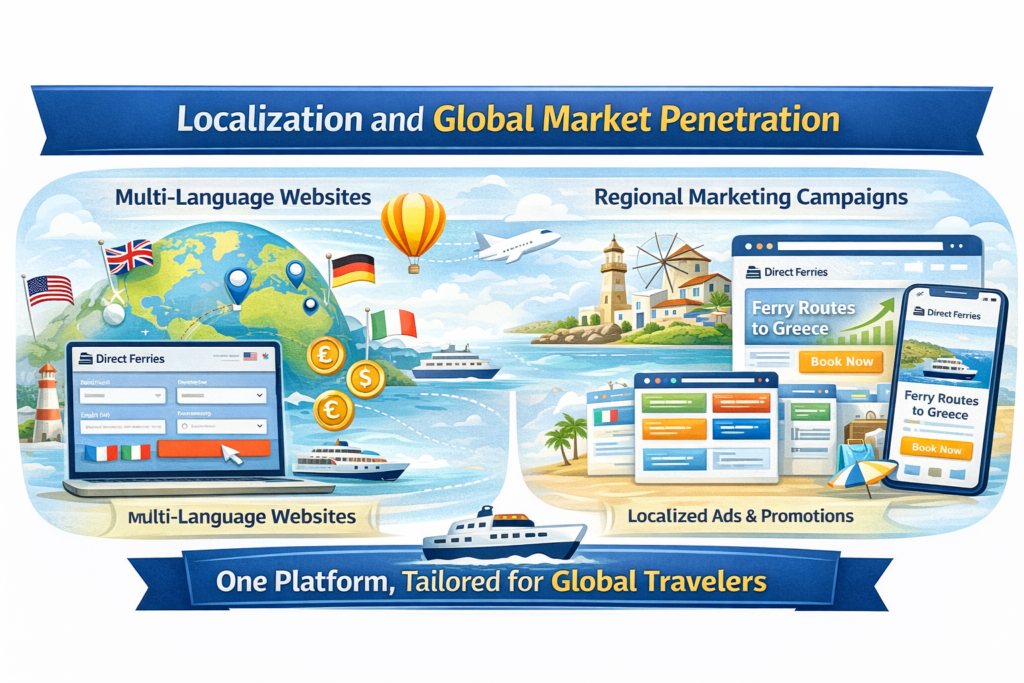
Ferry travel is inherently international, which means localization is critical. Direct Ferries operates websites in numerous languages and currencies, allowing travelers from different regions to browse routes comfortably.
The platform is localized for markets including the UK, France, Germany, Spain, Italy, and many other countries. Localization goes beyond simple translation. The site adapts pricing displays, payment methods, and promotional messaging to suit each region.
This strategy dramatically improves conversion rates because travelers are more likely to book when the website feels native to their market.
Regional Marketing Campaigns
Different regions have different ferry travel behaviors. For example:
- Mediterranean routes are popular for island tourism
- Northern Europe ferries are often used for vehicle travel
- Asia-Pacific routes may serve short-distance commuter travel
Direct Ferries adapts its marketing campaigns accordingly. Seasonal promotions, destination guides, and travel deals are tailored to regional travel patterns.
Strategic Partnerships and B2B Distribution
API and Platform Integrations
A major pillar of Direct Ferries’ growth strategy is B2B distribution through APIs. Travel platforms can integrate Direct Ferries’ database and instantly access thousands of ferry routes.
This turns the company into a global ferry distribution infrastructure, similar to how airline booking systems operate.
Partnerships With Travel Platforms
A notable example is the integration with the travel platform Omio, which allows travelers to access ferry routes alongside trains and flights. This type of partnership expands the reach of Direct Ferries far beyond its own website.
Instead of relying solely on direct traffic, the company embeds its inventory across multiple travel ecosystems.
Product-Led Growth Strategy
Mobile App and Booking Experience
The Direct Ferries mobile app allows travelers to compare routes, book tickets, and manage travel plans on the go. The app provides real-time pricing, availability, and booking features, making ferry travel planning much more convenient.
Mobile functionality is particularly important for travel platforms because users often search for transportation options while traveling or during trip planning.
User Experience and Conversion Optimization
The company places strong emphasis on simplifying the booking process. Travelers can quickly compare operators, choose departure times, and add optional services such as insurance or flexible tickets.
Clear price comparisons and transparent booking flows reduce friction in the purchasing process. That focus on usability is a crucial factor in the platform’s growth.
Competitive Advantage Over Ferry Operators
Value for Travelers
For travelers, the biggest advantage of Direct Ferries is convenience. Instead of visiting multiple operator websites, they can compare routes and prices in one place. This saves time and helps users find the best option quickly.
Value for Ferry Operators
For ferry companies, the platform provides additional distribution and customer acquisition. Smaller ferry operators benefit especially because they gain exposure to international travelers who might otherwise never discover their routes.
Lessons Marketers Can Learn From Direct Ferries
Direct Ferries demonstrates several powerful marketing principles:
- Aggregator platforms scale quickly by connecting supply and demand.
- SEO can drive enormous traffic when targeting thousands of niche queries.
- Localization increases global conversions.
- Partnerships expand distribution without high acquisition costs.
- Product-led growth improves retention and customer satisfaction.
These lessons apply far beyond ferry travel. Many modern digital marketplaces—from travel to e-commerce—follow similar strategies.
Conclusion
Direct Ferries is a fascinating example of how a niche travel service can become a global digital marketplace. By aggregating ferry routes from hundreds of operators and presenting them in a simple comparison interface, the platform solves a major problem for travelers. Its growth has been fueled by a combination of SEO dominance, strategic partnerships, localization, and product-driven innovation.
The company’s success highlights the power of the aggregator model. Instead of owning the transportation infrastructure, Direct Ferries focuses on owning the customer journey. By capturing demand at the search and comparison stage, it becomes the gateway through which ferry travel is discovered and booked.
For marketers, entrepreneurs, and digital strategists, the Direct Ferries story offers a powerful lesson: sometimes the most valuable business is not the one providing the service, but the one organizing the marketplace.
Frequently Asked Questions
Direct Ferries is an online travel aggregator that allows users to compare and book ferry tickets from hundreds of ferry operators worldwide.
The platform offers access to thousands of ferry routes worldwide and aggregates schedules and pricing from more than 250 operators.
The company earns revenue through commissions on ticket sales, booking service fees, ancillary travel services, and B2B integrations with travel platforms.
No. Direct Ferries does not operate ferries. It functions as a comparison and booking platform connecting travelers with ferry operators.
Its success comes from strong SEO strategy, global partnerships, route-based content, localization, and a scalable aggregator business model.
Table of Contents
Popular Posts

-
 Affordable Technical SEO Audit for Small Business: A Complete Guide26 Jun 2025 Blog
 -
 How to Get an Affordable Technical SEO Audit for Small Business27 Jun 2025 Blog
 -
 The Ultimate Local SEO Audit Checklist for Startups28 Jun 2025 Blog
 -
 Local SEO Audit Checklist for Startups: A Beginner’s Guide28 Jun 2025 Blog
 -
 Top On-Page SEO Audit Steps for Service Websites Every Business Should Know29 Jun 2025 Blog
 -
 The Impact of On-Page SEO Audit Steps for Service Websites on UX01 Jul 2025 Blog
 -
 Technical SEO for WordPress: The Ultimate Beginner’s Guide01 Jul 2025 Blog
 -
 Technical Mobile SEO Audit Tips for Developers02 Jul 2025 Blog
Related Post